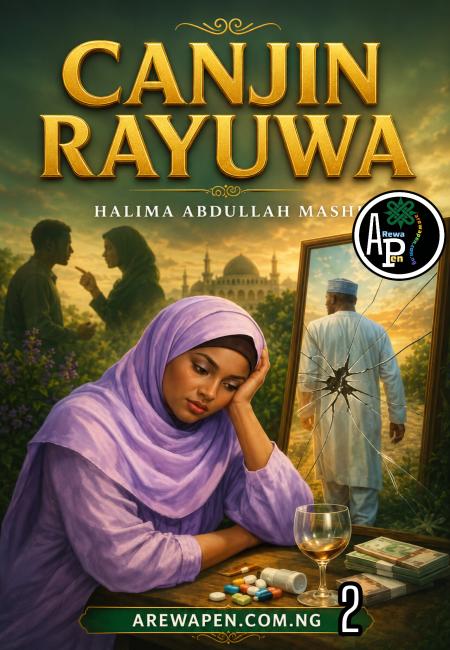



Rana Daya Book 3 Hausa Novels By Halima Abdullahi Mashi
01 Sun 06, 2025
114
675
File Size: 200.06 KB
Format: PDF
Phone Number:
Group: Alkalam Kaduna Writers Association
Compiler: Alkalam Kaduna Writers Association
Book Album: None
Last Download: 21 minutes ago


RANA DAYA BOOK COMPELET DESCRIPTION
I was walking along, singing the song that our schoolteacher taught us yesterday, when suddenly I heard someone call out, "Hey, Daughter of Gwaggo!" I turned around to see which disrespectful person was teasing me today, because every single day when I step outside, someone is bound to tease me.
It turned out to be Salisu. Actually, he was exactly the person I had come out to find so I could collect the money for the *ƙosai* (bean cakes). I said, "Hey Salisu, where is my *ƙosai* money? Every time you take items on credit, you never pay. I swear you must pay me back today!" He replied, "Hey Deeje, I refuse to pay, especially since you are being so disrespectful to me." He then walked right past, leaving me standing there. I muttered, "By God, today you will learn who Deeje really is!" I picked up a stone and shouted, "Salisu, turn around and look!" As soon as he turned around, I hurled the stone straight at his forehead, hitting him with a loud *thud*. I immediately bolted and ran straight back home.
As for Salisu, he clutched his forehead and began to wail, crying, "By God, you will pay for this, Deeje! And as for your *ƙosai* money, if I ever pay it, I am a bastard!" In no time, a crowd gathered to sympathize with Salisu because he had sustained a nasty injury; blood was gushing from his forehead, which had swollen up massively. He was rushed to a pharmacy to stop the bleeding, where the wound was washed and bandaged. From there, he went straight to the police station, and they brought a whole vehicle full of police officers to Deeje’s house.
Meanwhile, when I entered the house, I found that Gwaggo had finished her chores and had already set aside food for me. I sighed, "Phew, I’m so tired!" I headed toward our small kitchen area, scooped some food, sat down, and began to eat. Hearing the clattering of dishes in the kitchen, Gwaggo muttered, "Truly, you stubborn stray goat of a kitchen-thief, your days are numbered today!" She picked up a large wooden stick and marched into the kitchen, intending to land a heavy blow on the intruder, only to realize it was actually Deeje. She said, “Hey Deeje! By God, you almost visited the afterlife today. I thought it was that stubborn goat. Haven't I forbidden you from entering without uttering a proper greeting?”
Suddenly, we heard a loud pounding on the front door, as if someone was trying to break it down. I said, "Let me check, it’s probably Salisu." I walked to the door, and upon opening it, I saw a police officer with a massive belly and a baton in his hand. I let out a loud scream, crying, "Gwaggo, help me! They are going to take me away!" Right then and there, I actually wet my pants out of pure terror, because I absolutely detest the sight of police officers.
The officer barked, "Hey, shut your mouth!" I stammered, "By God, it wasn't me, Officer Big-Belly! For God's sake, please leave me alone!" He turned around and asked Salisu, “Is she the suspect?”
Just then, Gwaggo rushed out and exclaimed, "What on earth is happening? What am I seeing, Hajara? Salisu said, "This girl did this to me, and I want her to taste exactly what she inflicted on me." The officer looked at him and said, "What? Because of this little girl, you made us deploy a whole vehicle full of a police squad? Hey, how old are you?" I cried out, "Oh no, I am ruined, Gwaggo! He said I will rot in prison until I die—I swear, he said it in English!" Hearing this, Gwaggo fell to her knees, pleading, “Sir, please do not take my granddaughter away. I swear we have no one else but God.”
Another officer asked, "How old are you?" Gwaggo stood up and answered, "She should be about eleven years old." The officer turned to his superior and said, "Boss, she is just a child." Then he asked me, "So what happened that made you injure him like this?" I replied, "I only went to collect the money for the *ƙosai* he bought. It has been almost three days since he ate it without paying, and then he insolently told me to come collect it at night. That’s why I did it to him." Gwaggo began to exclaim in shock, saying, "Salisu, is this how you repay a trust? This girl is a sacred trust left in my care." She burst into tears. Salisu defended himself, saying, "I swear, Gwaggo, she is falsely accusing me! That is not how it happened!" The police officer barked at him, "So you are the type who exploits children? Are you going to confess, or what? Arrest him!" he ordered the other officers.
We returned inside the house, but my stomach was in absolute knots from the panic. I rushed to the restroom and came out looking completely exhausted. I lamented, "Oh, poor me, Deeje! Look at the trouble I've landed in today." Gwaggo called out, "Deeje, come here." I went and sat beside her. She said, "Tell me the absolute truth, Deeje. I know your character well. What really happened earlier when I sent you to collect the *ƙosai* money from Salisu?" I answered, "Gwaggo, you know how Salisu is. He outright refused to pay, and that's why I did that to him." She sighed, “Deeje, you really need to settle down. Ever since you were three years old, you have brought nothing but distress to my heart. And now, it even involves the police, Deeje?”
I replied, "You know very well that I never look for trouble with anyone, but if anyone looks for trouble with me, I never let it slide. Let me go grind the beans for the *ƙosai*, Gwaggo." I stood up and began preparing the beans.
The next morning, I woke up early, gathered the frying utensils for the *ƙosai*, and took them out to the roadside stall where Gwaggo does her frying. It was right at the edge of our street. After dropping the items, I took the soaked beans to the local mill to be ground. When I returned, I found that Gwaggo had already lit the fire and was waiting for me. She said, "Welcome back, Deeje. You took quite a while today; was there a long queue?" I replied, "There wasn't much of a queue, it’s just that Habibah was milling extremely slowly with her sluggish attitude." I set the ground beans down and added, "I’m going to quickly get ready for school. You know our exams start today." She said, "Alright, hurry up, and make sure to stop by and collect some *ƙosai* to take along with you." I replied, "Okay," and headed home.
After dressing up, I went to Gwaggo, took the *ƙosai*, and collected some allowance for the bus fare. The school, Kukawa Primary School, was located at the outskirts of the town. It was a government public school built in our village, Kukawa. Kukawa is a small town, but it has a dense population. Every Sunday, we host a major market day that even draws people from the city to shop. The Kukawa market has everything from livestock to fresh garden vegetables and traditional ingredients.
When school closed for the day, we were all scrambling to board the school bus. No one usually dared to mess with me because they knew it would result in a massive scene. The bus was packed with students. Today, Zeenatu was rudely shoved out of the vehicle by Fauziyya, who claimed it wasn't Zeenatu's seat, before smugly taking the spot for herself. Seeing this, I marched up and forcefully shoved Fauziyya out of the bus onto the ground, because I was already fed up with her behavior. I snapped, “Who do you think you are to shove Zeenatu when she sat down before you? Is this bus owned by your father?”
Furious, Fauziyya picked herself up and grabbed me, trying to throw me out as well. However, I held firmly onto the bus window with my feet and gave her another hard kick, sending her falling to the ground again. The entire bus erupted into laughter. Everyone disliked Fauziyya anyway because she was notoriously arrogant, constantly bragging just because the bus belonged to her older sister's husband. She yelled, "I swear to God, from today onward, none of you will ever step foot in this bus again! It doesn't belong to your fathers anyway!" The students burst into laughter again. I retorted, "We will absolutely board it! This bus belongs to everyone's father!" This triggered even more roaring laughter. Fuming with rage, Fauziyya stormed back inside, took a seat, and glared intensely at me. I returned her glare shot for shot, as I am not one to back down. That was how we rode all the way back to our neighborhood.
When I got down and headed home, I saw Salisu standing at the entrance of his shop, watching me. He jeered, "Hey, Daughter of Gwaggo!" I completely ignored him. He sneered, “Just you wait, Deeje, you will eventually fall into my hands, and you will learn a bitter lesson.”
I went straight inside our house, began taking off my school uniform, and walked toward the kitchen while talking to myself…
*I wonder what Gwaggo cooked for us today?* Just then, I heard her call out, "Deeje, come here!" I mumbled to myself, *Gosh, this old woman worries too much.* I walked into her room, and she said, "Your food is right here, but unless you step out and give a proper greeting, I will not give it to you." I replied, "Good grief! I'd rather go without a bath than go without food." I marched back to the front door and began shouting greetings repeatedly, even adding some cheeky dramatic flair. Exhausted by my antics, Gwaggo came out holding a metal bowl and playfully threw a small object at me. I ducked, laughing. She smiled and said, "Deeje, I wonder when you will finally grow up and get some sense. Go on inside and take your food." I ran into the room and began devouring the meal, praising her cooking because Gwaggo was an exceptional cook. After cleaning the plate, I performed my prayers and went to sleep, as it was my daily routine to take a nap after school before heading to evening Islamic school (*Karatun Allo*).
Today was Saturday, so we didn't have school. Whenever I was free from school, I took over the frying of the *ƙosai* while Gwaggo handled the sales. While I was busy frying, Auwal walked up and said, "Hey friend, it’s been a while. You’ve been quite scarce lately." I replied, “Oh, Brother Auwal, are you implying you don't know where our house is that you claim I've been scarce?”
I continued with my frying, and he smiled, saying, "If I keep arguing with you, we'll end up fighting right now." Just then, a customer named Bello snapped, “Hey, I've been standing here waiting for you to serve me *ƙosai*, but you went ahead and handed it to Mallam Hashimu instead, even though I gave you my money first! If you are going to disrespect me like this, just give me back my money!”
Mallam Hashimu gently intervened, saying, “Oh, I'm sorry, young man. I didn't realize you had already paid her, that's why I collected it. Please have patience.”
I turned and said, "Baba Hashimu, what kind of patience are you asking him to have? If he can't wait, no one is forcing him to stay; he can take his money and go elsewhere!" Without even giving him another glance, I went back to my frying.
Bello flared up, “Deeje, are you speaking to me like that? Who do you think you are? Let me tell you, the attitude you exhibit that others tolerate won't work with me. I will thoroughly humble you!”
I stood up abruptly and challenged him, "Hey Bello, you ask who I am? I have a proper lineage because I am a Muslim!" He scoffed, “Cut the nonsense, where is this lineage you speak of? A proper lineage means showing your mother and father. Since I have both a mother and a father, I clearly have a better lineage than you. Why don't you show me your own parents?”
Furious, I stood up completely and shouted, “Bello, how dare you insult my birth and call me a bastard! Even if you don't see my parents, you see my grandmother, and she gave birth to one of them! When did you even enter Islam to know what is right and wrong?”
Auwal quickly intervened, saying, "Come on, Bello, what is wrong with you? Can't you see she is just a child? Why can't you behave like an adult? Deeje, please drop this matter, it's escalating unnecessarily." I threw Bello's money back at him and said, "We are not selling any *ƙosai* to you, go find some elsewhere!" I began serving the other customers. Just then, Gwaggo arrived and asked, "What is all this noise I'm hearing?" Auwal quickly tried to cover it up, saying, “It’s nothing, Gwaggo, we were just chatting.”
I spoke up, “No, Brother Auwal, tell the truth! Gwaggo, it’s Bello. Just because I served Baba Hashimu first, he insulted me and called me a bastard, so I told him I wouldn't sell any *ƙosai* to him.”
Gwaggo's face darkened with intense anger. The townspeople's persistent malicious rumors questioning her granddaughter's legitimacy was an insult she could no longer tolerate. She vowed that Bello would learn a bitter lesson today.
She immediately began packing up the frying equipment. I helped her pack, and she told Auwal, "Auwal, please help her carry these things home. I am going straight to Bello's house." Delighted, I said, "Alright, Gwaggo!" In my heart, I really wanted to go along to witness the drama, but since she was going to fight for my honor, I contentedly headed home. Brother Auwal helped me carry the items all the way to our courtyard entry hall (*zaure*) and set them down. I thanked him. Despite my fiery attitude, Brother Auwal never took offense; he would only smile and attribute it to childhood immaturity.
When Gwaggo reached Bello's house, she unleashed a torrent of furious tirades, shouting, "Where are the owners of this house who claim to have a superior lineage?" Bello's mother peeked out into the courtyard and said, "Oh, it’s Gwaggo. Please come inside out of the sun." Gwaggo snapped, “I didn't come here to sit down! Where is that son of yours who looks like an Igbo man? You better warn him to stay completely away from my granddaughter, otherwise, I will report him directly to the authorities!”
Bello's mother, who spoke with a distinct southern accent, pleaded, "Please forgive us, Gwaggo. *So, I told this boy not to go carry rigima (trouble) for me, oh.* Bello will face my wrath when he gets back." Gwaggo, misinterpreting the English words, barked back, “What do you mean I am *kariya* (a dog)? And you think Bello is the one telling the truth just because I didn't go to Western school (*boko*)? Let me tell you, I am far above you all, and my granddaughter is also getting a Western education!”
Bello's mother quickly clarified, "No, Gwaggo, *what I mean* is please have patience, he will never do it again." Just then, Bello walked into the house, asking, "*What's going on?*" He froze instantly upon seeing Deeje's grandmother.
Gwaggo yelled, "I am the one *goni kon* (going on)! I swear, she has exposed your complete lack of manners!" His mother ordered him to apologize to Gwaggo immediately. He held his ears respectfully and said, “*I'm so sorry, Gwaggo.*”
This further enraged Gwaggo, who misunderstood "sorry" as *saurayi* (boyfriend). She screamed, "Boyfriend (*saurayi*)?! Heaven forbid! You are not my granddaughter's boyfriend! Even if she ran completely out of men to marry, she would never marry the likes of you!" It was pure chaos! Realizing the old woman was completely misinterpreting their words and could not be reasoned with in that state, they simply began to placate and beg her. She finally left, still shouting angrily all the way back to our house.
I was sitting at home waiting for her return when she burst through the door. "Hey, Deeje, come here!" she ordered. I rushed to her side, and she immediately landed a heavy, stinging slap on my head. I cried out in pain, clutching my head. She scolded, "You shameless girl! You wanted to turn me into a laughingstock? So you and Bello are secretly dating? The moment I arrived, he started saying I am *goni kon* (going on) and that he is your *saurayi* (boyfriend)!" Frustrated, I cried, “I swear to God, Gwaggo, he is lying! He is not my boyfriend, he is just trying to slander me, and I am going to make him pay for this!”
Knowing my fiery temperament, Gwaggo realized I would actually carry out my threat. She calmed down and asked, "Alright, Deeje, are you absolutely sure there is nothing going on between you two?" I replied, "Yes, I swear." She said, "Alright, let the matter drop then. Go set up the cooking pot and make us some dried okra soup. For God's sake, make it as delicious as the one you made the other day." I grumbled, "Okay, Gwaggo," with a sour face. I was still boiling with rage and wouldn't be satisfied until I thoroughly humiliated Bello for trying to manipulate my grandmother against me. I lit the fire and began cooking.
Gwaggo kept reminding me, "Be careful not to burn yourself," noticing that I was cooking in a tense, agitated mood. I finished the cooking while lost in my thoughts, eagerly anticipating tomorrow so I could meet Zeenatu and tell her what Bello had done. The next morning, I woke up and performed my prayers. Gwaggo usually didn't wake me up for prayers because she believed it wasn't strictly mandatory for me yet, considering I was only eleven years old amidst all this drama. I ate the leftover food she kept for me, took a bath, put on my school uniform, and stopped by her stall to collect some *ƙosai* and my bus fare before heading straight to Zeenatu’s house.
The moment I arrived, I narrated the entire incident to her. She exclaimed, "You mean he’s going to get away with it scott-free?" I fiercely replied, "I swear to God he won't! No one escapes the wrath of Deeje!" She laughed and high-fived me, saying, “Alright, let’s hurry to school before Uncle Sani gives us a severe beating like donkeys.”
We rushed out to board the bus. Since the students hadn't fully gathered yet, we easily found good seats and sat down. Fauziyya was glaring intensely at us, but we didn't give her a single glance; we had no time for her today because our focus was entirely on Bello.
When we arrived at school and entered the classroom, Uncle Sani was already there. He barked, “Late again today! Don't you girls ever wake up early?”
He ordered, "Oya, on your knees!" We stood there blinking in confusion, not understanding what he meant. He grabbed a cane from the class monitor and began lashing us severely, shouting, “Idiots! Lower your heights! Why are you standing over me like planted trees?”
After receiving the painful beating, I whispered to Zeenatu, "I swear to God, I am leaving Western school to return fully to Islamic school. There, you get actual knowledge and spiritual rewards. But this Western education is pure abuse! Look at Uncle Sani with his massive head and tall frame. They always say tall people have their brains located in their knees!" We both burst into muffled giggles.
He overheard us and roared, “Oh, so you think I am a madman? Khadijah Auwal and Zeenatu Ismail, get up and follow me right now!”
We followed him behind the classrooms to a horribly foul-smelling garbage dump. He ordered us to clear it. I flatly refused, saying, "By the Quran, I will not clear this trash! Why should I contract a disease for no reason? I’d rather be expelled!" He snapped, "Is that so? Well, today you are definitely leaving this school!" He marched straight to the headmaster's office to report us.
The headmaster let out a long sigh and told him, “I am honestly tired of Deeje's constant cases. I would have expelled her countless times, but her grandmother breaks my heart. She came and explained everything to me—how the girl is an orphan, and if she is expelled, things will only get worse for her. She is just a wild, stubborn child, and she clearly doesn't even want to learn.”
He summoned us to the office. We walked in and knelt down respectfully to greet him. He said, “Khadijah Auwal and your friend, I am thoroughly exhausted by your endless cases. But I am going to take a strict measure regarding you two. Now, go back to your class.”
He then sat Uncle Sani down and explained
As you approach the town of Giwa, the very first house that catches your eye to the southeast is a magnificent mansion roofed with shining red aluminum sheets, encircled by towering iron gates popularly known as Mahdi-ka-ture. Within its walls lies an entire estate that swallows up fifteen modern flats.
If you lift your eyes upward, golden letters gleam boldly on the archway: ABUBAKAR BAMALLI GIWA ESTATE. The houses are neatly arranged, painted in the soft color of boiled eggshells—beautiful, clean, and soothing to the eye. Yet, among the fifteen houses, one stands apart: the very first house.
It is the largest of them all, the only one built with an upper floor. Its mistress is an elderly woman of about seventy-five, known as Hajiya Hadiza Giwa, but to her children and grandchildren she is simply Hajjah.
It would surprise you to know that despite the enormity of the mansion, she alone lives in it as the sole wife of the household. All fifteen children were born by her—one after the other—without the presence of a co-wife or rival.
The people of Giwa would tell you this was due to the deep love her late husband, Abubakar Bamalli Giwa, had for her, combined with her own good character and kind dealings with everyone. After his passing, her children did not taste much of orphanhood, for Hajjah became their wall of refuge. This did not mean she spoiled them; far from it. She upheld strict discipline for every child and grandchild alike.
No one dared raise their voice at her; no one could contradict her. No decision could be taken in the family without her consent. She was sharp-minded and wise, quick to sense the intentions behind every movement of her children and grandchildren. She was firm, unbending, and precise in judgment.
Though she showered love on her grandchildren, she would never allow the younger ones to disrespect their elders. Her grandchildren adored her—more, in fact, than their own parents. One by one, many left their parents’ homes and came to live in the Big House, as they called it. They claimed life was sweeter there: endless varieties of food, tales of wisdom and folklore, and above all, the warm embrace of their grandmother, who would soothe and console them whenever their parents upset them.
Yet love did not blind her to justice. If a grandchild misbehaved, Hajjah would not beat them herself, but she would summon the authority of Baban Giwa to discipline them.
After A.B. Giwa’s death, she stood firm in raising his descendants and in keeping his vision alive: that their bloodline must intermarry among themselves. Whether they liked it or not, Hajjah saw to it. Only later, when they experienced the blessings of such unions, did they return to thank her.
This practice led to the spreading and multiplication of the Bamalli lineage throughout Giwa and beyond. Wherever they went, people recognized them instantly by their striking resemblance—the distinct tribal mark carved by their family barber on the cheeks of every child during naming ceremonies.
Though they lived secluded in their estate, their professions and government jobs took them out to Kaduna and Zaria. Within the mansion itself also lived the extended family: widowed relatives like Kaltume and Kubra, who busied themselves with cooking and keeping the house in order, despite the abundance of servants.
The boys’ quarters had been set aside for her grandsons, many of whom abandoned their parents’ houses to stay with Hajjah. The granddaughters she raised were mostly married off within Giwa or Zaria, strictly within the family line. Of Hajjah’s fifteen children, ten were sons and four daughters.
Her late husband, Abubakar Bamalli Giwa, had been a wealthy man in his time, a son of Giwa by ancestry. His livelihood was farming—vast crops of maize, millet, sorghum, wheat, rice, potatoes, yams, and vegetables. His harvests filled truckloads bound for markets across the region. He owned more than ten sprawling farmlands, inherited from his forefathers, along with countless rental houses in Giwa, Kaduna, and Zaria.
His wealth was immense, and to this day his fortune continued to grow because his children upheld zakat and did not trifle with Allah’s rights in their wealth.
The eldest son, Alhaji Mukhtar Abubakar Bamalli, managed their company branch in Kaduna, Bamalli Food Crops and Cash Crops Production. Though his home was in Kaduna, he had a house in the estate and returned for festivals. Next was Professor Ahmadu A.B., a lecturer in Agriculture at Ahmadu Bello University, living mostly in Zaria. Then came Na’ibi A.B., caretaker of their farms; Ibrahim A.B., who managed their rental properties; Barau A.B., in charge of distribution; followed by Sani, Sadi, and Salisu, each with their own roles in the family trade.
Her daughters, too, were married within strong ties: Hauwa in Kaduna, Ladidi in Zaria, Hafsatu in Giwa, and the youngest, Rabi—the darling of the family—who had just married Muftahu, a cousin working in Kano.
Despite her seventy-five years, Hajjah’s energy seemed ever renewed. She looked far younger than her age, free of the common ailments of old women. She herself possessed wealth from her late husband, and her roots traced back to Zaria’s Tukur-Tukur quarters.
In the estate stood a grand mosque where they all gathered for prayers, men and women separated by a curtain. Rarely did anyone perform their prayers at home unless necessity forced them. Next to the mosque was a small clinic with a resident doctor and nurse, ensuring constant care. Even in Giwa’s main food market, half the shops belonged to the Bamalli family.
The grandchildren were raised with prayer, discipline, and education. Among them, none dared date or choose a spouse outside Hajjah’s consent. Her word was law.
At present, three little girls under her wing—Ummi, Zanirah, and Fa’iza—were her focus. Among the boys, there were many young men in secondary school and university, most of whom had left their parents’ homes to live with her.
But one grandson stood out among them all: Fa’iz, the son of Alhaji Mukhtar. He bore the name Abubakar, after the late patriarch, and was, in Hajjah’s eyes, his living photocopy—both in looks and in character. A memorizer of the Qur’an at just fifteen, he could recite in the voices of famous Saudi reciters. He had even studied secondary school in Madinah under government sponsorship.
Fa’iz’s bond with Hajjah was unlike any other. She favored him openly, giving him the best portions of food, calling him Hafizi, and keeping a special room for him in the boys’ quarters. His devotion to her was equally unmatched—he supplied her with kola nuts, olive oil, black seed, and musk perfume, never letting her lack any of her favorite things.
Living alongside him were his younger sister Zanirah, who had refused to return to her mother after Haj pilgrimage, and their cousin Khadija (Ummi), the daughter of Aunty Hauwa, who had also stubbornly insisted on staying with Hajjah since childhood.
Finally, there was Fa’izah Ahmad Abubakar Giwa—the narrator herself—daughter of Professor Ahmadu Bamalli. Taken away from her inattentive mother at age five, she too was raised in Hajjah’s household, forming a trio with Ummi and Zanirah.
Together, the three girls grew under Hajjah’s watchful eyes, their daily mischiefs and quarrels constantly settled by her patient judgments. And so, in the estate of Abubakar Bamalli Giwa, life continued—a world of discipline, wealth, tradition, and the ever-present shadow of Hajjah, the matriarch who bound them all.
Related Novels
 VIEW ALL

Rana Daya Book 3 Hausa Novels By Halima Abdullahi Mashi
Halima Abdullahi K Mashi
01 Jun, 2025 | 676 views

CANJIN RAYUWA BOOK 1 HAUSAWA NOVELS BY HALIMA ABDULLAHI K MASHI
Halima Abdullahi K Mashi
02 Jun, 2025 | 1269 views